


Description
Hansen Foot Valve Sock to fit FV50-63mm (2″ – 2 1/2″) / HFVFSL
This is a filter sock for foot valve use to help filter and stop particles entering the valve.
SPECIFICATIONS
- PRODUCT CODE: HFVFSL
- CODE MEANING: HANSEN FOOT VALVE – FOOT SOCK
- SUITS THE FOLLOWING FOOT VALVES (Available as seperate purchase)
- HFV50 50mm (2″) Hansen Foot Valve BSPT
- HFV63 63mm (2 1/2″) Hansen Foot Valve BSPT
For FV25-40mm Foot Valve Sock, refer to HFVFS. (Available as seperate purchase)
FOOT VALVE BROCHURE AND CHEAT SHEETS
- Refer to Hansen Australia Website.
FOOT VALVE HANDY TIPS AND COMMERCIAL VIDEOS
- Refer to Hansen Australia Website.
FOOT VALVE STEPS QUICK AND EASY INSTALLATION STEPS (See full installation in image gallery or attached image)
- Use a thread sealant on all threaded connections. We recommend Loctite 5331.
- Screw fitting into the foot valve. Do not over tighten. Hand tight plus maximum of two turns with tools.
- All pipe work must be adequately supported.
- This can be installed at any angle.
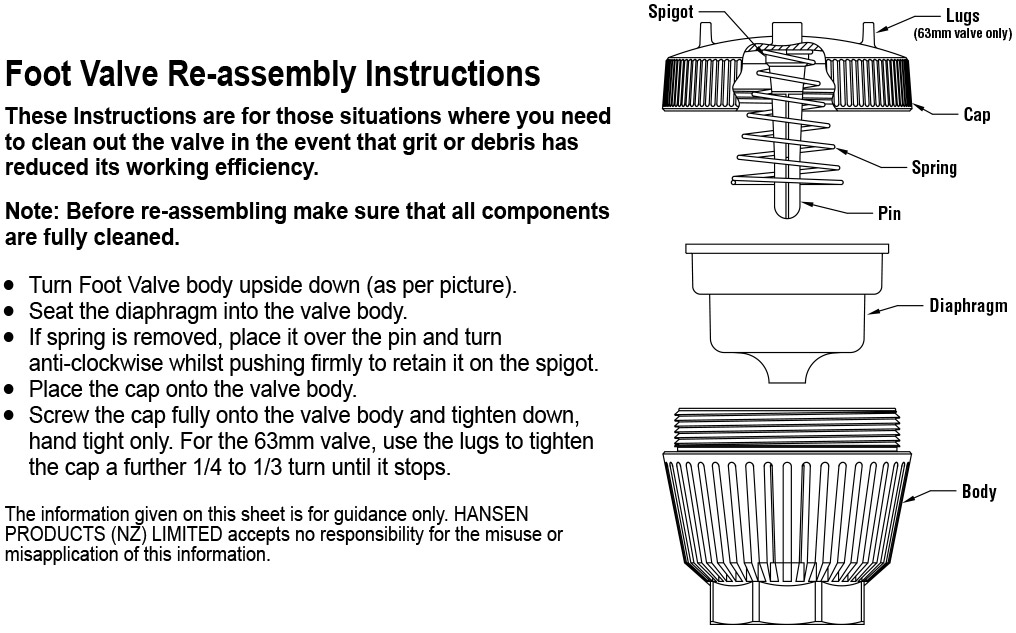
FOOT VALVE RE-ASSEMBLY INSTRUCTIONS (Refer to image gallery for preview chart)
These Instructions are for those situations where you need to clean out the valve in the event that grit or debris has reduced its working efficiency.
NOTE: Before re-assembling make sure that all components are fully cleaned.
- Turn Foot Valve body upside down (as per picture).
- Seat the diaphragm into the valve body.
- If spring is removed, place it over the pin and turn anti-clockwise whilst pushing firmly to retain it on the spigot.
- Place the cap onto the valve body.
- Screw the cap fully onto the valve body and tighten down, hand tight only. For the 63mm valve, use the lugs to tighten the cap a further 1/4 to 1/3 turn until it stops.
The information given on this sheet is for guidance only. HANSEN PRODUCTS (NZ) LIMITED accepts no responsibility for the misuse or misapplication of this information.
CHOOSING THE CORRECT CHECK VALVE (See full preview of chart in image gallery or attached images)
- Use the instructions and the flow chart to determine the correct Check Valve for your requirements.
- Because of the unrestricted Full Flow design of the Hansen Check Valve you will often find you will be able to choose a smaller Hansen Check Valve than most other check valves on the market. As the Flow Chart is based on head loss across a fully opened diaphragm firstly go to the table following headed “Flow Required to Fully Open Diaphragm” and check which valves sizes will not be fully open with your system flow.
- To Read the Check Valve Flow Chart, find your system flow across the bottom of the chart on this page and take a line vertically up the chart to size a valve with an acceptable head loss for your system.
- EXAMPLE: with a flow of 300lpm a CV50 will have a head loss of 1.1m and a CV32 will have a head loss of 4.4m. 300lpm will not fully open a CV63.
CHOOSING THE CORRECT FOOT VALVE (See full preview of chart in image gallery or attached images)
- Use the flow chart and technical specifications to determine the correct Foot Valve for your requirements.
- Firstly find your system flow across the bottom of the chart and then take a line vertically up the chart to the size valve with an acceptable head loss for your system. For dirty water applications choose the smallest valve that will be operating in the area shown by the thicker line with an acceptable head loss.
- EXAMPLE: If your pumping capacity is 400lpm a FV40 head loss will be 1.8m and a FV32 head loss will be 3.3m.
FREQUENTLY ASKED QUESTIONS
- QUESTION: I have an existing water line with a 40mm (1 1/2″) valve on it and I want to replace the valve with a Hansen Valve. Do I use the same size valve as my existing one?
- ANSWER: Kindly refer to the ‘Choosing the Correct Foot or Check Valve’ details and use these charts to determine the valve size required. In some situations, it is advisable to use a smaller Hansen valve than the existing non-Hansen valve.
- QUESTION: Can I use my Hansen fittings with my swimming pool/spa pool set up?
- ANSWER: No, as the high concentration of chlorine used in the water for pools will attack the material. The fitting material is only suitable for use with domestic water. Hansen products that are used in this application will NOT be covered by the limited lifetime warranty.
- QUESTION: Can the Hansen Foot Valves be used with salt water passing through them?
- ANSWER: The spring in the valves is made of 302 grade stainless steel, and may eventually corrode in the salt water. The spring is available as a replacement part if required. All other parts of the valve are fully resistant to salt water.
- QUESTION: Do I have to remove my valve from the line to service?
- ANSWER: No. The valve can be left inline for servicing. Refer to Re-assembly instructions (stated above) for full details.
- QUESTION: How do I know what size valve to use?
- ANSWER: Work out the flow of your pump (Ask for the pump installer/supplier’s advise as they can be a big help and can guide you best.) then kindly refer to “Choosing the Correct Check Valve or/and Choosing the Correct Foot Valve” guide and preview chart in the attached images.
- QUESTION: I find my check valves too often not sealing, I’ve been told I should have a filter upstream of the valve, is this the same with the Hansen Check Valve?
- ANSWER: All check valves should be screened upstream. The Hansen Check Valve can be serviced inline if the water is dirty.
- QUESTION: I have noticed that the Hansen Check Valve has a screw top, does that mean it can be serviced inline?
- ANSWER: Yes, the Hansen Check Valve can be serviced inline and any parts can be replaced if required.
- QUESTION: The dam I’m pumping from can get quite dirty at times, including some slime and weed. I find my existing foot valve requires constant cleaning. Will the Hansen Foot Valve solve this problem?
- ANSWER: Yes, the Hansen Foot Valve has been designed with the ability to work in dirty water situations and because of lower head losses of this valve you can select a smaller size than you normally would expect, thus with the higher velocities across the diaphragm the valve becomes self-cleaning.
- QUESTION: The river I pump from is fairly shallow so I do pump some sand at times and find my existing Foot Valves have to be replaced often. Is the Hansen Foot Valve also a throw away valve?
- ANSWER: No, although pumping sand is unadvisable because of the damage to the pump. With the screw cap service access to the Hansen Foot Valve, it is only needed to replace the parts that wear in these circumstances. Also, the Hansen Foot Valve can be installed at any angle, it can be installed the vertically above the suction pipe to keep it above the sand.
- QUESTION: What temperature can I use Hansen Foot or Check Valve at?
- ANSWER: Hansen have tested all its products for use with cold water up to a maximum temperature of 60°C (140°F). It is not recommended to use these products with temperatures higher than 60°C (140°F) as plastic expands due to temperature increases. Hansen cannot guarantee the products will perform when used with temperatures over 60°C (140°F). Hansen products that have failed in temperatures higher than 60°C (140°F) will not be covered by our limited lifetime warranty.
- QUESTION: When choosing my Foot Valve do I select a valve size to match the suction pipe diameter?
- ANSWER: No. The higher flow efficiencies of the Hansen Foot Valve you match your flow with the head loss your pump can afford, generally you will find the Hansen Foot Valve size will be less than the pipe diameter. To choose the correct sized valve for your application, kindly refer to “Choosing the Correct Check Valve or/and Choosing the Correct Foot Valve” guide and preview chart in the attached images.
- QUESTION: Why won’t my valve seal?
- ANSWER: (1) There may be something sitting between the diaphragm and diaphragm seating area. Pull the valve apart and clean out (replace diaphragm if damaged) as per assembly instructions; (2) Check to ensure that you are using the correct size valve for your situation (see choosing the correct foot valve or check valve)